Swiss Africa Cybersecurity Community at the “Science Diplomacy in Practice” Workshop
How can science and diplomacy contribute to lasting international partnerships? This question was at the heart of the workshop “Science Diplomacy in Practice,” which brought together researchers, diplomats, policymakers, and practitioners from Switzerland and across Africa.
Organized by the Federal Department of Foreign Affairs (FDFA) together with the Initiative Afrique, University of Bern, and the Swiss Leading House for Africa, the workshop provided a platform for exchanging perspectives on how scientific collaboration and diplomatic engagement can jointly create sustainable impact.
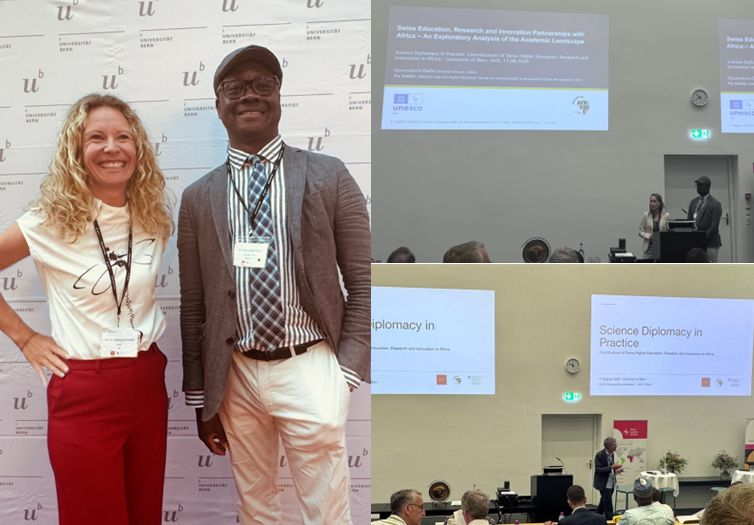
Presenting the Swiss Africa Cybersecurity Community
Prof. Dr. Bettina Schneider, participated in the workshop and presented the SwissAfricaCySec Community, highlighting its role in strengthening connections between researchers and practitioners working on cybersecurity in Switzerland and Africa.
The community builds on the understanding that cybersecurity is a global challenge, while its concrete implications and solutions are often shaped by local contexts. Creating accessible opportunities for exchange is therefore an important foundation for developing meaningful and sustainable collaborations.
The presentation focused on three dimensions of accessibility:
- Accessible Structures: Join the community. Build connections. Create opportunities for collaboration across Switzerland and Africa.
- Accessible Content: Cyber threats affect everyone. Learn about global cybersecurity challenges and contextualize them to local realities.
- Accessible Formats: Start small with online exchanges, build trusted relationships, and grow them into impactful research and innovation initiatives.
The presentation also highlighted SwissAfricaPayCyber, a new research project addressing cybersecurity and digital trust in the context of financial technologies and payment systems. SwissAfricaPayCyber aims to equip trainers involved in Swiss startup, market-entry, and internationalisation programmes with practical knowledge of payment systems and cybersecurity, particularly in relation to SME expansion. The trainers can then incorporate this knowledge into their own programmes and pass it on to the startups and entrepreneurs they support.
Where Research and Diplomacy Meet
A central takeaway from the workshop was the close relationship between research and diplomacy. While their approaches and objectives may differ, both rely on bringing people together, building trust, exchanging knowledge, and establishing long-term relationships.

“Science creates knowledge. Diplomacy creates partnerships. Both together create trustful and impactful collaborations.”Prof. Dr. Bettina Schneider,LinkedIn
For cybersecurity in particular, this intersection is highly relevant. Effective responses to digital threats require not only technological expertise, but also education, international cooperation, trusted networks, and an understanding of different social and institutional contexts.
A special thank you goes to the University of Bern Vice-Rectorate Research and Innovation, represented by Dr. Djouroukoro Diallo, for the invitation and for creating a valuable space for dialogue, networking, and collaboration.